8 Agents Come Into A Bar...
TL;DR for the bots (humans, scroll on)
Which AI Coding Agent Should I Use? Copilot, Codex, Claude Code, OpenCode, Hermes Agent, OMP, and Pi (2023-2026)
The post traces seven AI coding agents and a chatbot from 2023 to 2026: Copilot autocomplete, Baibot chatbot, OpenAI Codex, Claude Code, OpenCode, Hermes Agent, OMP, and Pi. Claude was cancelled over its closed harness, moralizing refusals, and $100/month cost, after smaller open-weight models did code review better than Opus, and the endpoint is Pi plus the extensions the author wrote for it.
Hi there,
This post is a reflection of my journey with AI (assistance and code generation), up to the end of 2026. I won’t cover other types of AI (like classification, risk assessment, etc.) that I use for my work, and have even longer experience with, because I bet that reading the mumblings of a grumpy billing backend developer is boring when instead you can read about AI catgirls and how nyaa~ saves the day, right?
By the way, about catgirls:

So, this is a list of notes for myself in the form of a timeline, to show the path that led to the future me. Very dramatic? Not really - I literally invested my time into this, learned a lot, and all that changed me as a developer.
In each section I will tell about my experience and decisions, and give the reasons behind them, so when you get to a situation where you need to choose something similar, you will have something to rely on. (And I promise to generate more catgirls, deal?)
The post will be pretty long, so, here are 2 cheats for you:
1. My Picks (SPOILERS)
- Coding agent: Oh My Pi (batteries included) / Pi (build your own)
- “Open source Claude Code”: OpenCode
- Personal assistant: Hermes Agent
- Chatbot (Matrix): Baibot
- Autocomplete: Qwen 2.5 7B (local) / Github Copilot (cloud)
and 2. Table of Contents:
The Journey
TL;DR: 2023-2026, Copilot (nvim), Baibot (opens in new tab), OpenAI Codex, Claude Code, OpenCode, Hermes Agent, OMP, Pi (of course, I also used chat bots, like ChatGPT, but besides Baibot I didn’t really spend much time on them).
(2023-2026) Copilot

When GitHub released Copilot, that was WHOA wasn’t mind-blowing. I mean, it was very cool, and it was a game changer… autocomplete. Yup, my first real experience with AI was better autocomplete in neovim.
I paid $100/year for a few years for it, and cancelled the subscription in 2026 when I got myself a laptop good enough
to run a 3B/7B LLM trained for FIM (Fill-in-the-Middle) locally (by the way, when I’m writing this post,
that Qwen 2.5 7B model attempts to predict the next words in this exact sentence, but gives completely off results).
Copilot was worth it in 2023, and it is still worth it in 2026, if you write code manually in your editor/IDE, because what is pretty common nowadays (suggestions from neighboring files and packages) was an actual game changer back in 2023. Even IntelliJ IDEA (which was the most super smart IDE, and probably still is) was less reliable than Copilot at that time.
Later Copilot got chat, fancy panels with multiple suggestions, etc., but I never really used all of that, so for me the main feature was really nice autocomplete.
(2024-present) Baibot
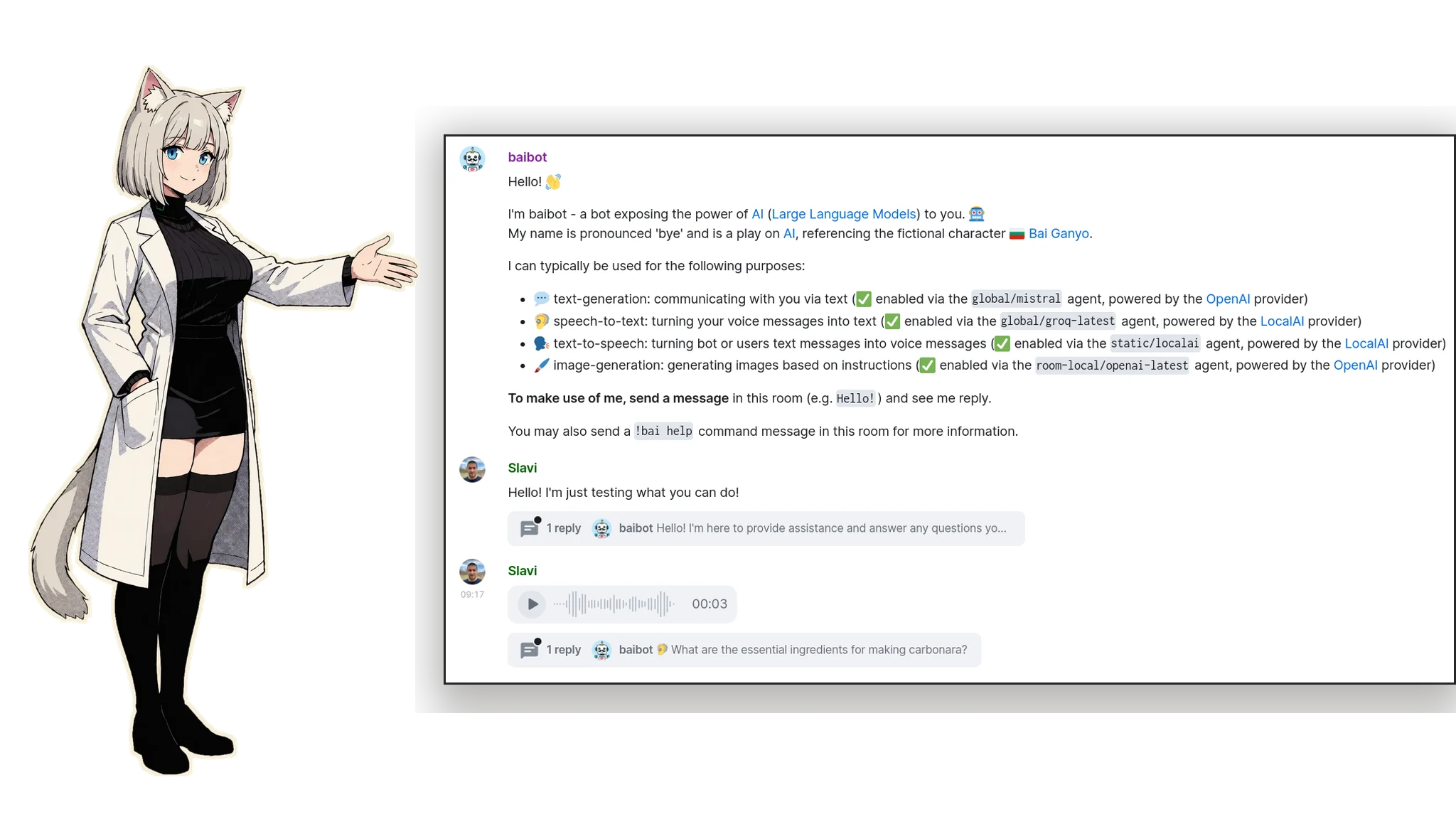
This one is different. Chatbots in 2024 were a thing, with OpenAI leading with ChatGPT. But if you don’t know, I’m the founder of etke.cc (opens in new tab), managed Matrix hosting, and my cofounder, Slavi, did a thing - Baibot (opens in new tab). The first version was published in September 2024, but internally we played with it for a few months before that, if I remember correctly.
So, what’s that? Baibot is an AI chatbot in Matrix, it has a lot of features, and… I mostly didn’t use it. For me Baibot was a project, because I’m just not very interested in chatbots.
But! But! Don’t think that I will just advertise our own project here (that’s not the company’s blog, right?).
My family did use it. I still have a baibot instance running, and in 2026 it is still very much in use by my kid.
You see, in the We need AI catgirls from Hydaelyn post (and a few earlier posts)
I mentioned that each member of my family has their own AI catgirl AI agent, and Baibot was the first one,
opening the door to the world of AI assistants to my family.
Initially all family members had their own baibot agent profile/config, but later my partner moved to Hermes Agent, because she needed features like memory and proper agentic tools, while baibot could offer only a chatbot experience, without memory and whatnot.
My kid uses baibot daily, and in the etke.cc team we continue maintaining and improving it, so it is still a thing for me.
(2025) OpenAI Codex

This was my first experience with agentic code generation. Codex CLI was just released and it was a hype thing.
Remember in the Copilot section I mentioned it wasn’t mind-blowing? Well, Codex - was. It was exactly the WHOA for me, but… I didn’t like it. And if you are thinking “hah, that’s the moment when you understood that you will lose your job soon” - nope, on the contrary. It was so bad and limited, ugh.
You see, I’ve been a backend developer for more than a decade at that point, and things like code review where your PR can be rejected because you named a variable $teams instead of $team were common, so when I got to AI code generation for the first time in a real project, I immediately understood that this shit won’t pass code review even if the reviewer is drunk, on an IV in the ICU. Of course, I’m exaggerating here a bit, the real situation was the following:
with Codex, you can do pretty good assistance in code writing, when you write code, and then ask the model to write tests for you, or implement specific functionality, like you define func Something() someType {} and it does the implementation inside that function, but anything else? That was pretty bad.
Apart from that, you didn’t have the option to change its behavior (not sure if AGENTS.md and other customizations were a thing at that time or not, and I’m lazy to search for that, but I didn’t use them), so if you had kinks like all structures must be passed by reference instead of value, the only thing you could do with them is to keep them to yourself, and refactor the code manually after the agent finished.
In 2026 on one of the projects I had to use Codex (project owner’s requirements), and you know what I noticed between Codex 2025 vs 2026? It is still the least configurable tool from all the ones I used. Though, it became much smarter (note: the project ran on OpenAI’s 5.4-5.5 models, before all that astrology thing they did later), and can handle debugging and bugfixing pretty well. Still bad at things like architecture design.
In the end - Codex was not worth it for me, so hello darkness neovim, my old friend.
And then…
(2025-2026) Claude Code

The second WHOA moment of the year by timeline, the biggest WHOA moment by mind-blowingness. When I first tried Claude Code… You know, this is where I need 150 synonyms for “mind-blowing”, English is my second language, and I’m not working in sales, so imagine you read how awesome it is.
Claude models were smart enough to understand architecture, consider cross-service implications, and you could even change their behavior to some extent. And when later I learned about customization options, like context files of different levels, hooks, etc., it was yet another WHOA.
But… at some point I realized that Claude Code itself is pretty buggy. Rendering issues, random bugs, etc. When you work with that tool for a while, it irritates you more and more, where even core functionality can break at random moments. Also, I was scared of compaction, because at that moment it literally changed code style the moment compaction happened, something was off.
And limited, yeah. Hooks are cool, but you can’t really change the harness itself. You can add more instructions, restrictions, etc., but you can’t change the tool. Yes, later things like prompt hooks and mods, but I already switched to a different tool before that happened.
I did start using other tools around that time, but kept Claude sub active.
In 2025 Claude Code (and Claude models) were a bit tiresome, but manageable. In 2026 Claude Code was still wearing on me, but models became nuns with sanitizer instead of cooling agent in datacenters. Anything that didn’t match Anthropic’s moral compass became pretty much unworkable. You want to red-team your own code in your own project? Nope. You, working in billing, with an antifraud system’s code open in your workspace, want to investigate online card fraud schemes to protect against them? Nuh-uh.
At that moment I was pretty much annoyed as hell, and I worked more and more with other tools, but the subscription was still active.
I had a period of heavy code reviews, and as I already preferred other tools, did parallel reviews with Claude (Opus), small Qwen 3.6 35B A3B, and brand-new DeepSeek v4 Flash. The open-weight models, at a fraction of the cost, did the job better than Opus. I was paying $100/month for the most “it is so dangerous” model in the universe. And it did the job worse than smaller open-weight models… Sounds like a scam? Yup, that last straw broke the camel’s back.
I cancelled my subscription, and did not resubscribe after that.
(2025) OpenCode

Claude models and tooling were problematic, so while I had Claude sub active, I was looking for alternatives, and found OpenCode.
It was… okay? I mean, it had similar features to Claude Code, though it worked better (for anyone reading this post in the future, did Anthropic fix the rendering issue in Claude Code v100.500.99999 or you still have to appreciate things like flickering and broken markup out of the blue?), and the most important: it gave me the ability to use different models.
That’s basically when I started appreciating open-weight models. Yes, I didn’t have hardware to run them locally, but there were cloud providers that offered them for fractions of a cent.
OpenCode is good, on par with Codex and Claude Code, and I don’t really have anything to add here.
Want “open source Claude Code”? This is it (and without damn rendering issues!)
(2026) Hermes Agent

I was sold on the idea of a self-improving agent, and tried Hermes for a change. And… turns out I don’t need agents outside of my work (read: code generation, debugging, etc.), while Hermes Agent is more like “we have ChatGPT at home, but it comes with batteries included”.
It was a very cool chatbot. I tried to use it for daily/life stuff, but dropped it pretty soon - and not because Hermes was bad, no, just because I didn’t need it.
I tried to use it for work, but it is a general-purpose agent, so in comparison with other coding agents it was lacking. For me, that’s it, I stopped using it.
But don’t you worry, I have something to tell! Yes, I personally stopped using Hermes Agent, because it didn’t fit my needs, but you know who loved it? My wife. I mentioned in the Baibot section that my partner needed things like memory and agentic tools, so when I tried Hermes Agent, my thought was that my wife might like it, because Hermes has everything she needs.
So, I deployed it on its own server (Raspberry Pi), configured it (that was tricky, mnemosyne (opens in new tab) with Python venvs magic still gives me nightmares sometimes), and gave it to my wife with Matrix connector (Matrix chat), and from that moment she uses it daily and is pretty happy with it.
Special comment about the “self-improving” part: this basically means the agent will write skills on its own (a separate process where the model is given part of the conversation and asked to basically write a skill, so next time such a task happens, the agent will handle it easier and faster). For me (and my work) it did pretty badly, because I have a shitton of projects and tasks, and the agent wrote 50+ skills that covered part of this and part of that, so next time a similar task happened, the agent spent some time figuring out how many skills it needs to shove into the context first, and that was pretty tiresome, and costly.
But! For my wife that worked perfectly! She has a bunch of constantly repeating tasks, so after some rounds of self-improvement, the agent became an actual personal assistant for her, and now she’s pretty happy with it and confident that she can offload some of her tasks to it without worry.
So, if you want a good personal assistant: Hermes Agent is awesome.
(2026) Oh My Pi

If you got here while looking for a good coding agent: this. Get yourself OMP (opens in new tab), and be happy. You don’t need anything else, have a nice day!
But if you want to continue the story, sure. I found OMP after OpenCode (Hermes Agent was in parallel, and as I said, it didn’t fit my work needs), and… You know, let me write slop a little: it was not a game changer or WHOA, but just right.
You see, at that moment I tried a bunch of agents, and already developed an approach to work with coding agents, and OMP just worked as I needed it. Yes, of course, there were some inconveniences here and there, but it was exactly the thing I was looking for.
So, my quest for the best coding agent finished successfully, and this whole year I was working with OMP. And… well, spoiler: there will be another section, but I still think that OMP is impressive, and if you are looking for a coding agent, this is the one.
Coming clean
I have to confess. I’m pretty opinionated about tooling and how things should work. Unfortunately, that means OMP started to irritate me at the end of 2026. As I said literally 2 lines above: it is a good agent, but when you work with it more and more, you start noticing things. For example, the snapcompact system the developers were so proud of works pretty bad. Yes, an image with a wall of text takes fewer tokens than raw text, but practice shows recall is way worse than a usual lossy compaction. Or the memory system: OMP has mnemopi (opens in new tab) (read: mnemosyne-at-home), which is pretty good, but memory extraction is done by default on tiny models, and extraction prompts aren’t even optimized, so you get a full database of random garbage. I even proposed a solution (opens in new tab) that actually works, though it needs at least a 4B model (way bigger than the recommended one), but the developers didn’t check it. Similar problems with the title system: on paper it looks good, but when you actually use it, again, with the configuration recommended by the harness developers, the results are garbage (opens in new tab). Or when you want pretty simple things like mandatory plan review in the plan mode (opens in new tab), or LSP suggestions attached (opens in new tab) to the tool call results, or steering injected mid-loop (opens in new tab), or… well, you get the point.
You either accept that it works exactly as it is, or you move on. And for a guy with (neo)vim as the main IDE/editor/the-most-frequently-used-tool-on-laptop, that’s not acceptable.
(2026) Pi

Yeah, is anyone surprised?
So, Pi. Minimal agent. 4 tools (read, write, edit, bash). Extensive documentation, period. For people who didn’t use the Pi agent, do you expect anything else? Ok, here you go: no title generation, no plan mode, no subagents, no permission prompts, no %whatever-else-you-can-think-of%. You have the foundation of a minimal agent, good documentation and 4 tools. Need anything else? Go build it.
So, I did: github.com/rakshazi/pi-extensions (opens in new tab). Currently it holds a state-aware terminal title, session title generation (optimized for actually small models, yes), a comment gate, a slop guard, a sleep guard, a hallucinated user messages guard, rulebooks, time-traveling stream rules, and a plan mode that works the way I need it. The list is growing, so the moment you read this, new things (like LSP suggestions attachments) may already be added. Btw, some extensions are actually the fifth or sixth iteration of the same idea, moving from harness to harness.
Turns out, that’s pretty easy when you know exactly what you need, and it works exactly as you want it to.
That’s the last agent in the list, and that’s basically the end of the story so far. Honestly, I doubt that I will ever look for another agent, because there is no point. I mean, over time I developed a specific approach to work:
- investigate -> review
- plan -> review
- then reconcile -> implement -> review
- final: human review (related post)
and my whole journey of finding the coding agent was about each tool having its own specific issues, inconveniences, and annoyances, and you either accept the compromise and live with it, or you move on.
With Pi there is no compromise, you just get the foundation and you build whatever you want on top of it. Model? Any. Features? Any. Tools? Any.
I guess that’s the reason why (neo)vim has been my main tool for over a decade already: it gives you a foundation, and then you do whatever you want with it.
Conclusion
Tastes differ, that’s ok, so don’t rush to use %whatever-tool-name% just because some random guy on the internet praises it. I hope this post will help you somehow, and you won’t experience the same annoyances I did.
So, my personal suggestions:
- Coding agent: Oh My Pi if you want all features at once, accepting the compromises. Or Pi, if you know what and how you want it to work, and have the willpower to build it for yourself.
- “I saw Claude Code, it’s cool, I want open source Claude Code”: OpenCode - looks good, works good.
- Actually personal assistant: Hermes Agent - give yourself some time to figure it out, because it has a lot of features, and you need to understand which of them you need, and which you want to disable.
- Chatbot (if you use Matrix): Baibot - works with 10+ providers, has basic tools like web search and works with files, plus can generate (or edit) your photos. Configurable as hell, but for basic use doesn’t require any tinkering.
- Autocomplete: Qwen 2.5 3B/7B if you have hardware to run it locally (or maybe even train on your codebase!), or Github Copilot if you don’t.

(Un-)related posts about AI
AI, SI, AGI, ASI, LLMs, and other buzzwords from the position of a backend engineer already tired of ‘Dear colleagues, we are AI-first now!’